

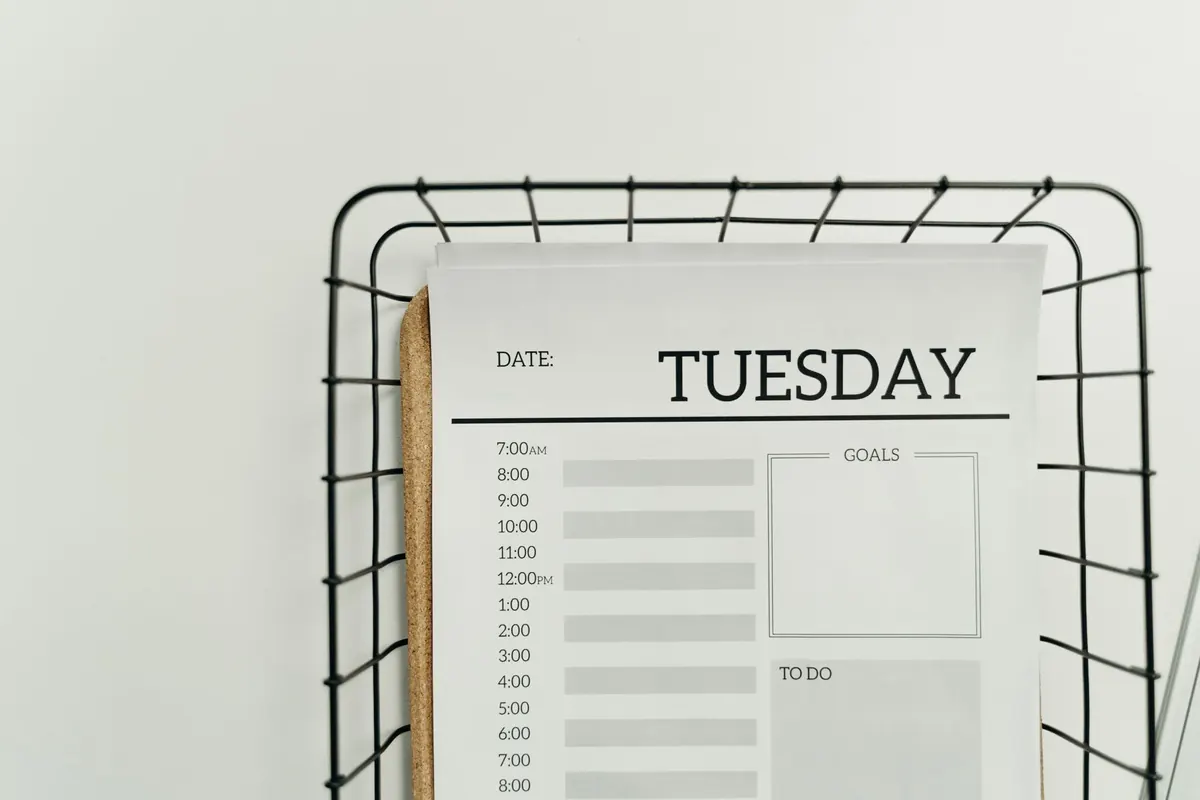
Most notes don't fail because they were badly written. They fail because nobody looked at them again. A meeting note sits in the wrong notebook, a half-formed idea lingers at the bottom of a page, and the thing you promised a colleague on Tuesday is still buried under three shopping lists. Twenty minutes a week fixes most of that.
What follows is a checklist you can run on the same day each week, in the same order, until it becomes automatic. It works whether you keep everything on paper, in an app, or in an entirely reasonable mix of the two.
Set the scene before you dig in
Pick a slot you can keep. Friday afternoon, as you close your laptop, suits a lot of people: the week is still fresh and Monday-you benefits. Sunday morning with coffee works too. What matters is that it's a fixed point rather than a vague intention.
Then set a timer for twenty minutes. Have four things within reach: your main notebook or notes app, your inbox, your calendar, and your task list. Put your phone somewhere you can't see it.
The aim is not a beautiful system. It's a working one. You are making decisions, not admiring your handwriting.
The four passes
Run the review as four passes rather than one long rummage. Each pass has a single job, which makes it much harder to drift off halfway through.
1. Clear: gather everything into one place
Empty the pockets, the sticky notes stuck to the monitor, the back pages of the notebook, the voice memo you recorded in the car park. Move it all into one working pile. Don't organise anything yet — collecting and judging are different jobs, and doing them at once is how a five-minute task becomes a forty-minute one.
If something is plainly rubbish — the note that says only "Thursday?" with no context — bin it now. You will not decode it later.
2. Connect: attach each note to something bigger
Go through the pile and ask one question of anything worth keeping: where does this belong? A complaint from a customer might belong with that customer's file and with your notes on packaging. A line you copied from a book might belong with a theme you keep returning to. If a note has no home at all, that tells you something too — it's probably a stray thought rather than a resource.
Adding a single line at the top of a note — a project name, a person's name, a date — takes seconds and saves minutes later. Linking is what turns a pile of paper into something you can actually use.
3. Archive: close the loops
Anything finished, decided or dead leaves the working pile. Archive rather than delete for most things, and date your archive so you can find your way back to it. A simple rule: reference material and completed projects go out of sight, live tasks stay in front of you.
If you're unsure how long to keep contracts, receipts or financial records, ask your accountant or another relevant professional rather than guessing — the answer varies by situation and by country.
4. Action: pull out the next steps
Every open loop in your notes needs one of three things: a date, a person, or a decision. If a note implies something to do, move that something into your task list and write it as a verb. "Ring Sam about the quote" beats "Sam / quote", because in three days the second version tells you nothing.
If a note only needs a decision — keep it or not, reply or not — make the decision now and write down what you chose. A good share of any notes backlog is simply undecided things wearing a disguise.
The twenty-minute checklist
Print this, copy it into a note, or keep it as the first page of your notebook.
- Gather (2 minutes). Bring every loose note, memo and scrap into one pile.
- Skim and mark (5 minutes). Work from the newest notes backwards and mark each one: act, file or bin.
- Move tasks (4 minutes). Send every action to your task list with a verb and a date.
- Link (3 minutes). Connect useful notes to a project, person or theme.
- Archive (3 minutes). Move finished material out and empty the working pile.
- Look ahead (2 minutes). Check next week's calendar for anything that needs preparation.
- Stop (1 minute). Close the notebook. The timer is not a suggestion.
When the pile has got out of hand
If you've let things build for three months, don't try to review all of it in one sitting. Set the timer for twenty minutes and handle the top layer: the last fortnight of notes, where the live tasks are. The older material can wait until you have a spare hour, and much of it will turn out to be bin-worthy once the pressure is off.
Alternatively, give yourself two one-hour sessions across a couple of evenings to clear the backlog properly, then return to the weekly rhythm. What you want to avoid is a permanent state of catching up, which is what happens when the review only ever gets done in emergencies.
Three traps worth avoiding
- Rewriting instead of deciding. Tidying the wording of a note feels productive and changes nothing. The job is to choose what happens to it.
- Building a new system every week. Pick one place for tasks and one place for reference, then leave them alone. A system improves through use, not through redesign.
- Reading without moving. If nothing has changed hands — no task moved, no note filed, nothing binned — you've been browsing, not reviewing.
Make it stick
Attach the review to something you already do without thinking: closing the laptop on Friday, the first coffee on Sunday, the train home. Keep the checklist where you'll see it, and taped inside the notebook cover works well, since that's where you'll be looking anyway.
If you miss a week, don't double up. Take the next slot and carry on. The point of a twenty-minute review isn't the twenty minutes; it's that when someone asks about the thing you wrote down, you know exactly where it is and what you decided to do about it.
Photo: cottonbro studio / Pexels